How Much Does a Small Business Website Cost in the US?
If you build it yourself on a website builder, a small business website costs about $19 to $29 a month on Squarespace's entry plans, billed annually. If you hire a professional, you pay a one-time project fee set by the scope of the work. Clutch, a directory of web design companies, says most projects reviewed on its platform cost under $10,000, and US web design companies most often list rates of $100 to $149 an hour. Either way, you'll also pay every year for a domain, hosting and upkeep. The worksheet below helps you work out your own three-year number.
Website cost at a glance
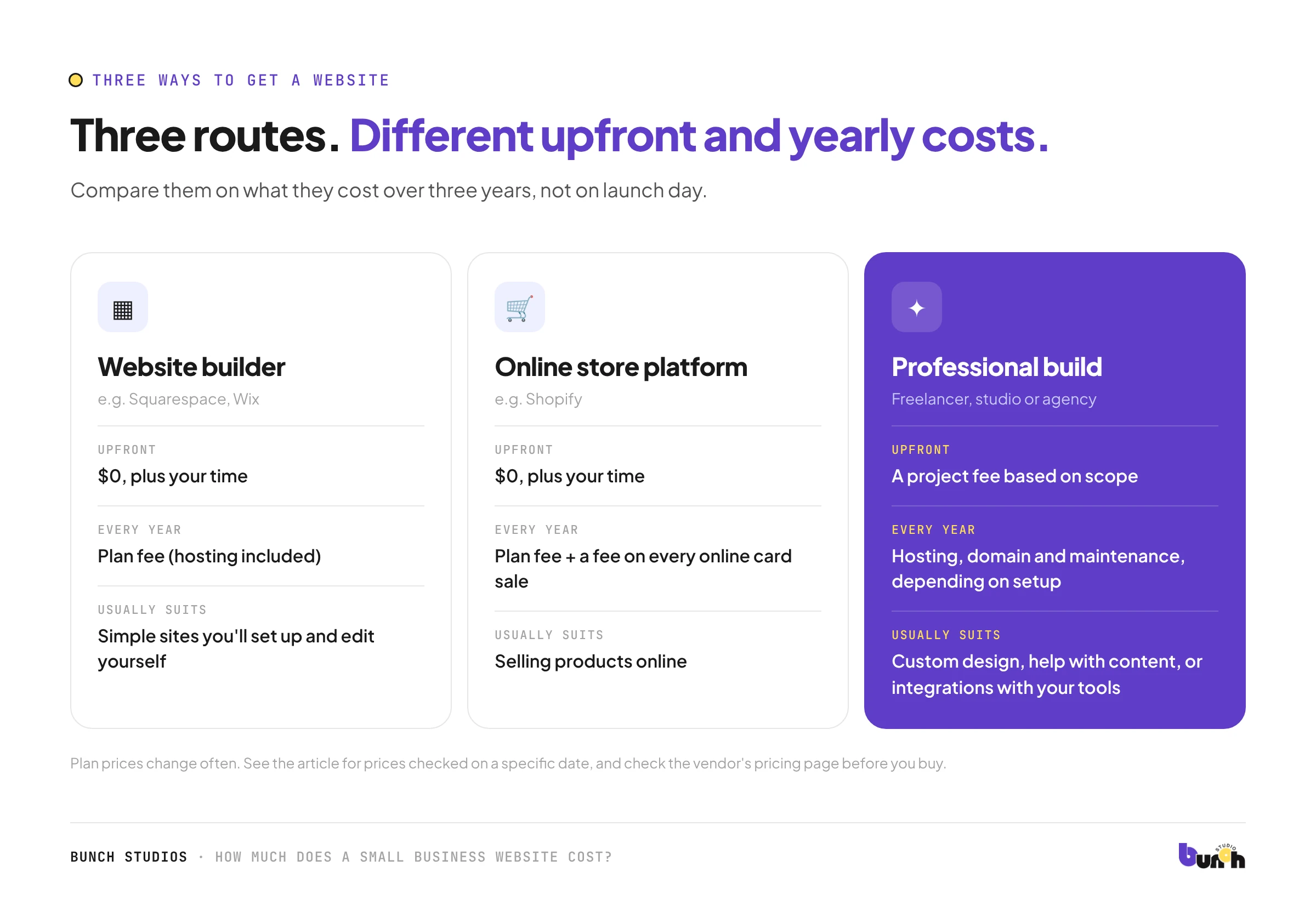
| How you build it | Upfront | Every year | Usually suits |
|---|---|---|---|
| Website builder (e.g., Squarespace) | $0, plus your time | $228 (Basic) or $348 (Core), billed annually | Simple sites you'll set up and edit yourself |
| Online store platform (e.g., Shopify Basic) | $0, plus your time | $348 billed yearly, plus 2.9% + 30¢ per online card sale | Selling products online |
| Hiring a professional (freelancer, studio or agency) | A project fee based on scope | Hosting, domain and maintenance, depending on the setup | Custom design, help with content, or integrations with your tools |
Prices from Squarespace and Shopify, checked October 13, 2026, before tax. Plan prices change often, so check the vendor's page before you buy.
Why you won't find a trustworthy "average"
Search this question and you'll see answers from a few hundred dollars to tens of thousands, usually with no source. There are three reasons the numbers disagree so much.
- "Website" covers very different things. A five-page site for a consultant and an online store with hundreds of products are both "small business websites."
- Freelance pricing is barely measured. The US Bureau of Labor Statistics publishes pay data for web developers and designers, but it covers employees and leaves out the self-employed, who make up about 18% of web developers and 13% of web and digital interface designers (BLS). For context, the median annual wage in May 2025 was $92,650 for web developers and $104,000 for web and digital interface designers. Those are salaries employers paid staff, not prices a freelancer or studio charges a client, which also have to cover tools, overhead and unbilled time.
- Directory figures describe their own users. Clutch's numbers come from companies listed on its platform and the reviews their clients leave (Clutch). They're useful as a signal, but they mix project types and countries.
So this guide gives you sourced numbers where they exist, and a method for the parts nobody measures well: your own quote.
What you're paying for in a professional quote
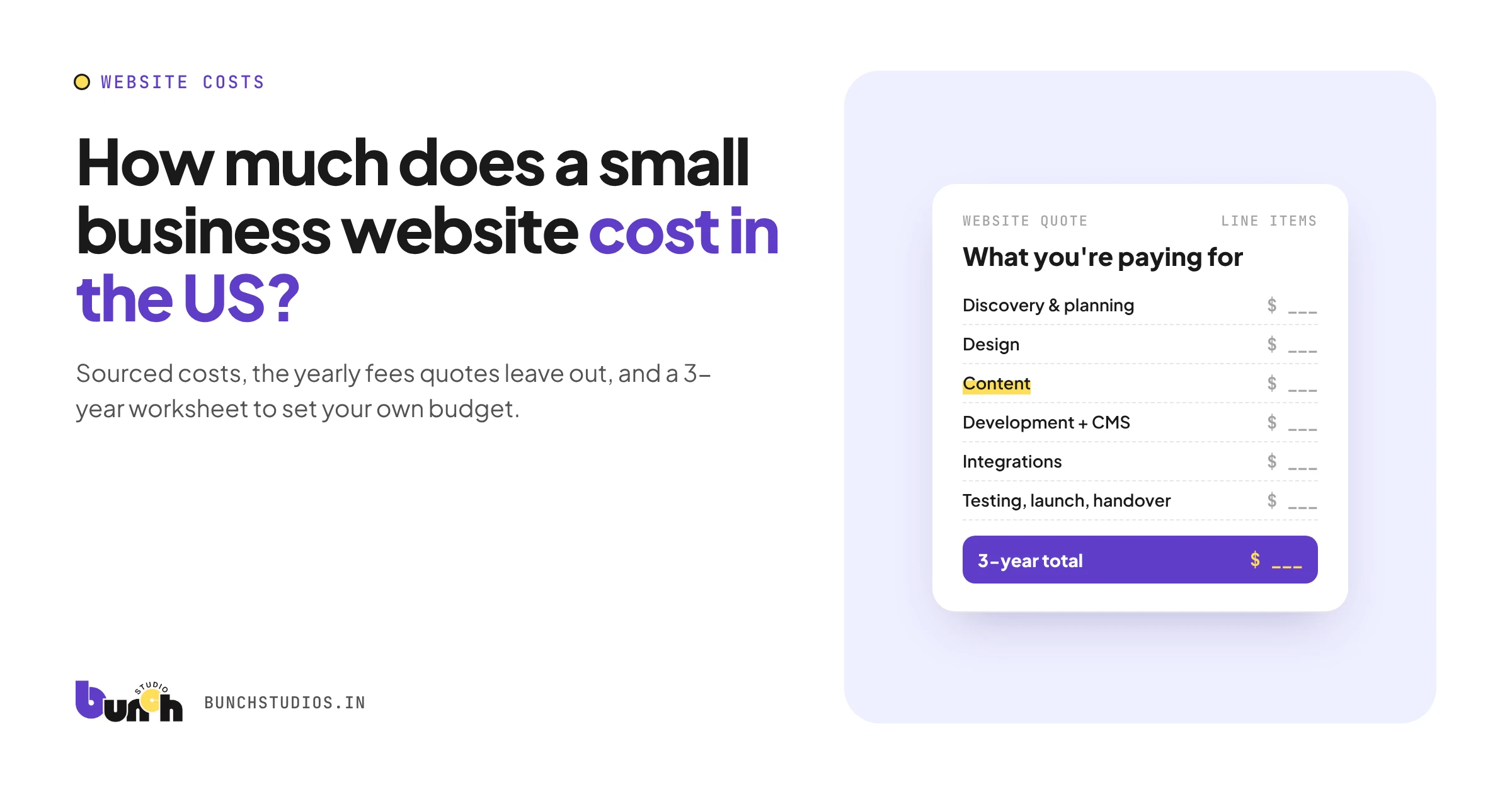
A website quote is a bundle of separate jobs. Knowing them lets you compare quotes line by line instead of by headline price.
- Discovery and planning: your goals, customers, and what the site needs to do.
- Site structure: which pages you need and how visitors move between them.
- Design: page layouts for phones and desktops, and the visual style.
- Content: the words on every page, plus photos and image licenses. This is the line people most often forget to budget for.
- Development: the front end (what visitors see) and the back end or CMS (where you edit the site).
- Integrations: booking, payments, forms that feed your CRM or email tool, analytics.
- Testing: browsers, phones, forms, page speed and accessibility checks.
- Launch: connecting your domain, setting up hosting, and redirecting old URLs if you're replacing a site.
- Handover: showing you how to edit the site and giving you every login.
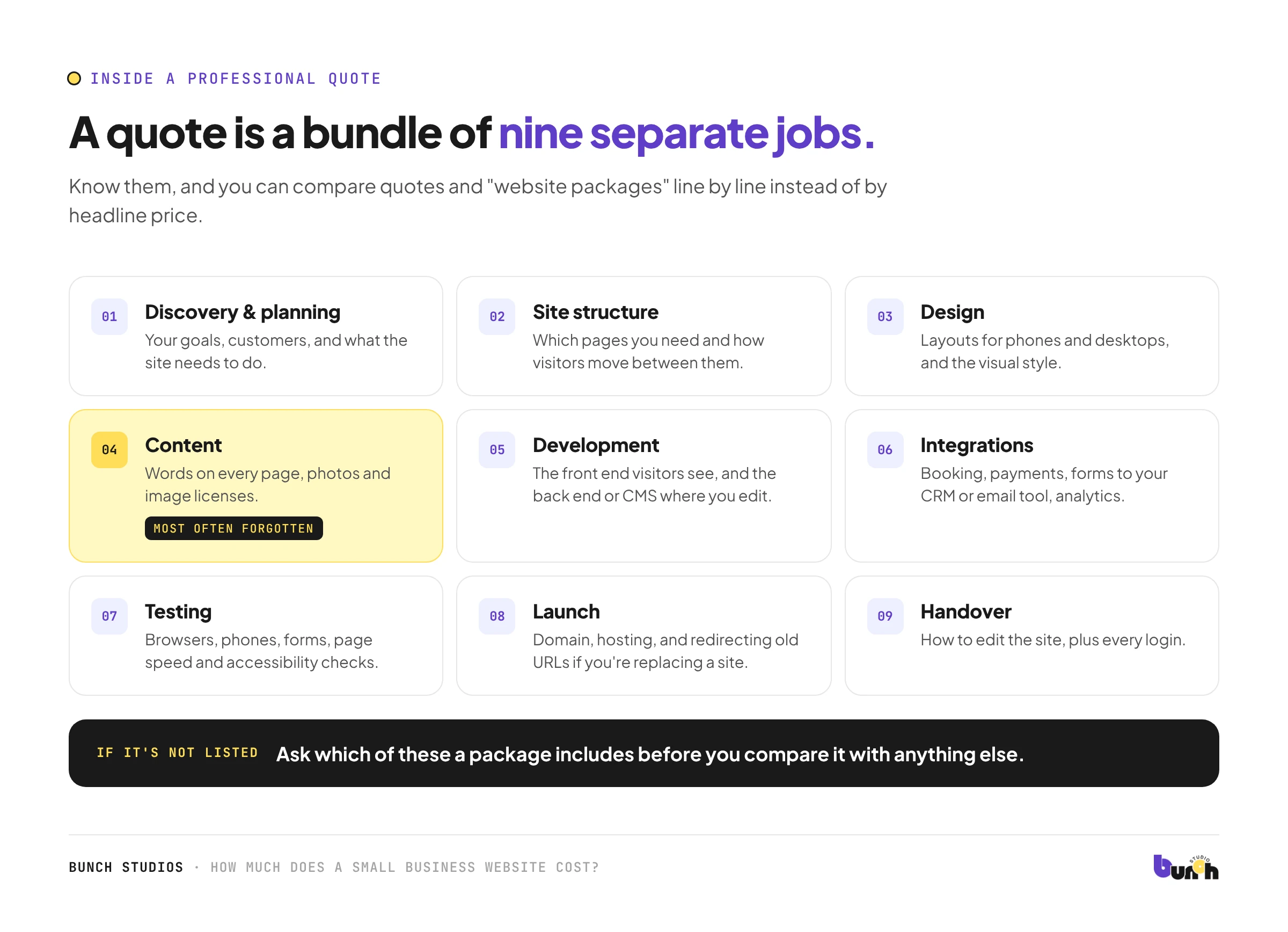
If a quote or package doesn't say which of these it includes, ask before you compare it with anything else.
The five scope decisions that move the price most
1. Template or custom design
A template gives you a finished layout to fill in. Custom design means someone plans and designs layouts around your business. That takes more hours, and you pay for them.
2. Who writes the content
If you hand over finished copy and photos, that work is off the bill. If the provider writes or sources them, it's on the bill. It's also the step that most often delays launch.
3. Integrations
Every system the site has to talk to, such as a booking calendar, a payment processor or a CRM, adds setup and testing time. Some also add a monthly subscription.
4. Unique page layouts, not page count
Ten service pages that share one layout cost far less than ten pages that each need their own design. When you compare quotes, ask how many distinct page templates are included.
5. Accessibility and performance standards
The Web Content Accessibility Guidelines (WCAG), published by the W3C, set testable success criteria at three levels: A, AA and AAA (W3C). Building and testing to a stated level takes time, so ask which level a quote covers and how it will be checked. The same goes for page speed: ask what will be tested and how.
Recurring costs most quotes leave out
The build is a one-time cost. These come back every year:
- Platform or hosting. Builder plans include hosting. A custom-built site needs a hosting plan, and your quote should say whose account it's on.
- Domain renewal. Watch for first-year promotions. Squarespace, for example, includes a free first year of domain registration on annual plans, then renews it at its standard rate (Squarespace).
- Business email. An address at your own domain is usually billed per user, per month.
- Payment fees. On Squarespace's Basic plan, online store sales carry a 2% transaction fee on top of card processing, which starts at 2.9% + $0.30. Core and higher plans drop the transaction fee to 0% (Squarespace). Shopify Basic charges 2.9% + 30¢ per online card payment, plus a 2% fee if you use a third-party payment provider (Shopify).
- Maintenance and updates: security updates, backups, fixes, and small changes after launch.
- Paid apps and integrations: booking tools, email marketing, forms, chat.
- Content changes: new pages, updated prices, seasonal offers. Free if you edit the site yourself; billed if someone else does it.
Your three-year website cost worksheet
Compare options on what they cost over three years, not on launch price. A cheap launch can cost more by year three once fees, renewals and your own time are added.
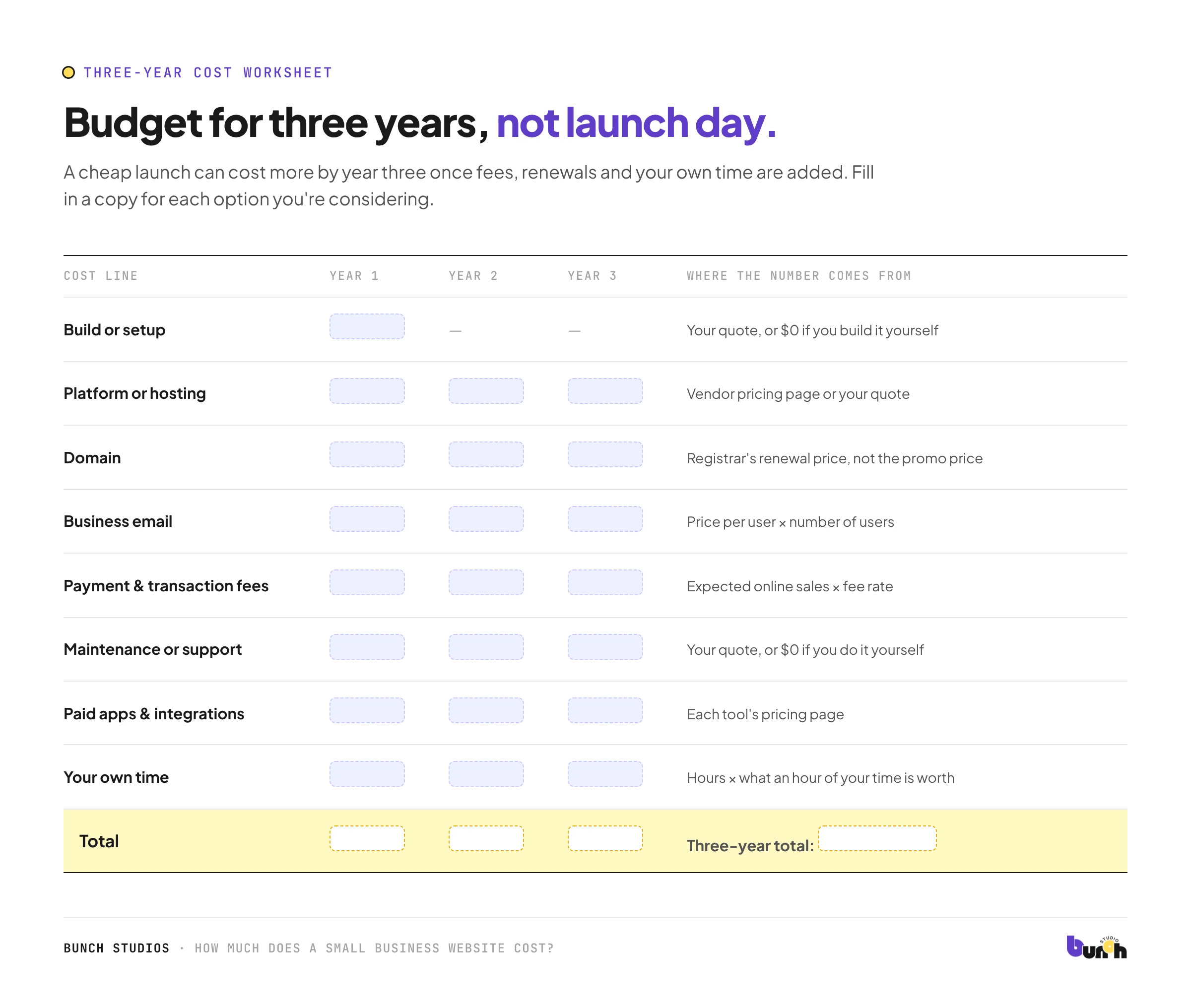
| Cost line | Year 1 | Year 2 | Year 3 | Where the number comes from |
|---|---|---|---|---|
| Build or setup | ___ | — | — | Your quote, or $0 if you build it yourself |
| Platform or hosting | ___ | ___ | ___ | Vendor pricing page or your quote |
| Domain | ___ | ___ | ___ | Registrar's renewal price, not the promo price |
| Business email | ___ | ___ | ___ | Price per user × number of users |
| Payment and transaction fees | ___ | ___ | ___ | Expected online sales × fee rate |
| Maintenance or support plan | ___ | ___ | ___ | Your quote, or $0 if you do it yourself |
| Paid apps and integrations | ___ | ___ | ___ | Each tool's pricing page |
| Your own time | ___ | ___ | ___ | Hours × what an hour of your time is worth |
| Total | ___ | ___ | ___ | Three-year total: ___ |
Worked example (website builder only): Squarespace Core billed annually is $29 a month, or $348 a year, so $1,044 over three years for the plan alone. Basic is $684 over three years, but it adds a 2% fee on online sales. Add domain renewals for years two and three, business email, and the hours you'll spend building and updating the site, and you have a true three-year number to set against a professional quote.
How to read a website quote
Before you sign, get written answers to these:
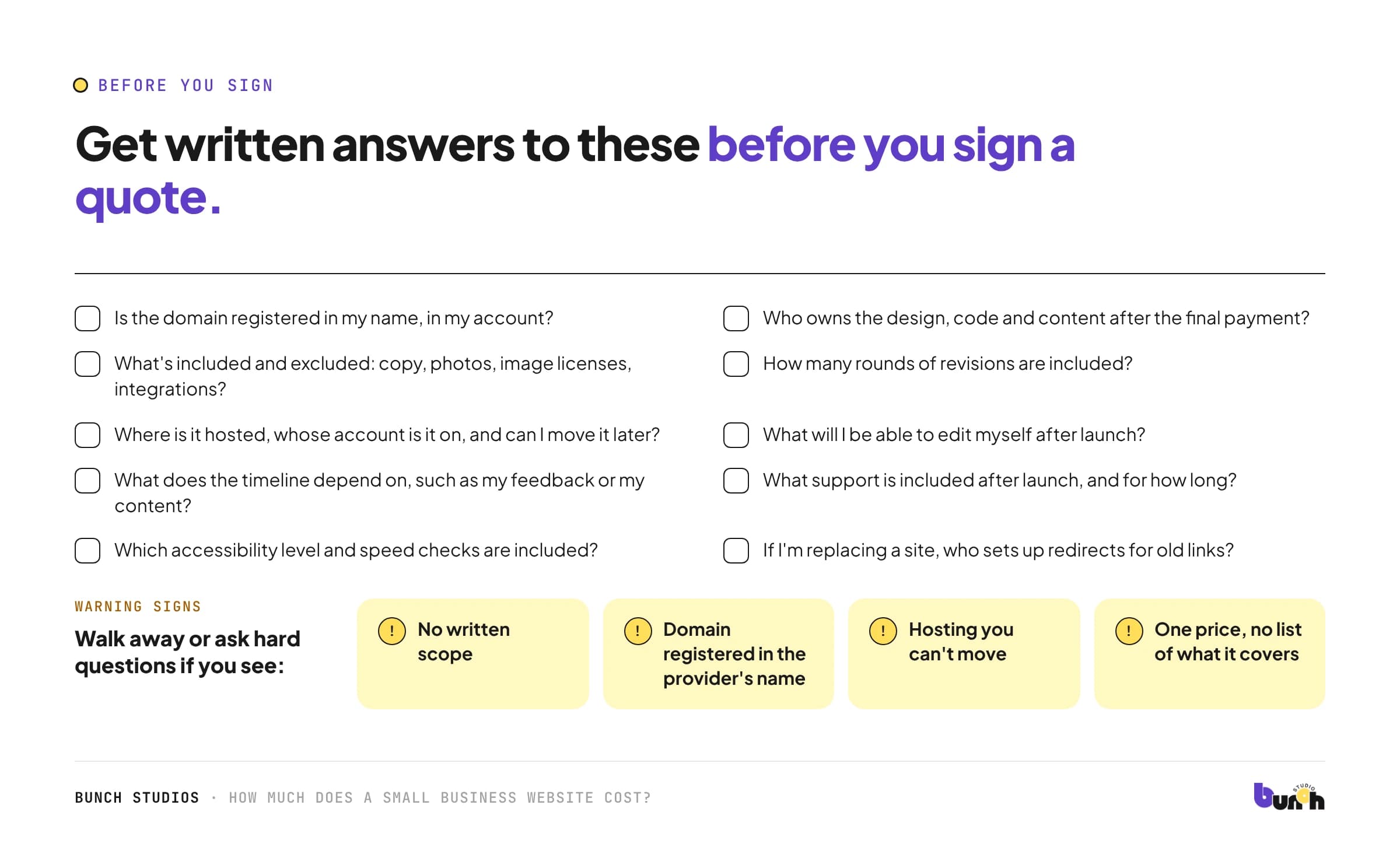
- Is the domain registered in my name, in my account?
- Who owns the design, code and content after the final payment?
- What's included and what's excluded: copy, photos, image licenses, integrations?
- How many rounds of revisions are included?
- Where will the site be hosted, whose account is it on, and can I move it later?
- What will I be able to edit myself after launch?
- What does the timeline depend on, such as my feedback or my content?
- What support is included after launch, and for how long?
- Which accessibility level and speed checks are included?
- If I'm replacing a site, who sets up redirects so old links and search traffic aren't lost?
Warning signs: no written scope; a domain registered in the provider's name; hosting you can't move; a single price with no list of what it covers.
Three examples: how scope changes the bill
These are hypothetical scenarios to show how scope works. They are not real clients or real prices.
A solo consultant needs five pages, already has the copy, and only needs a contact form. Scope is low on every driver above. A website builder may be all they need.
A home-services company wants a page for each service (all sharing one layout), online booking, and a quote form that goes straight to their inbox. Integrations and content become the biggest lines in the quote.
A small product brand wants to sell 30 products with shipping options. Product setup, payment fees and the platform plan now drive both the build cost and the yearly cost.
When a website builder is enough
A builder is often the right call if:
- you need a handful of pages and you're happy to edit them yourself
- a template fits your brand without much change
- the integrations you need are ones the builder already offers
- you have more time than budget
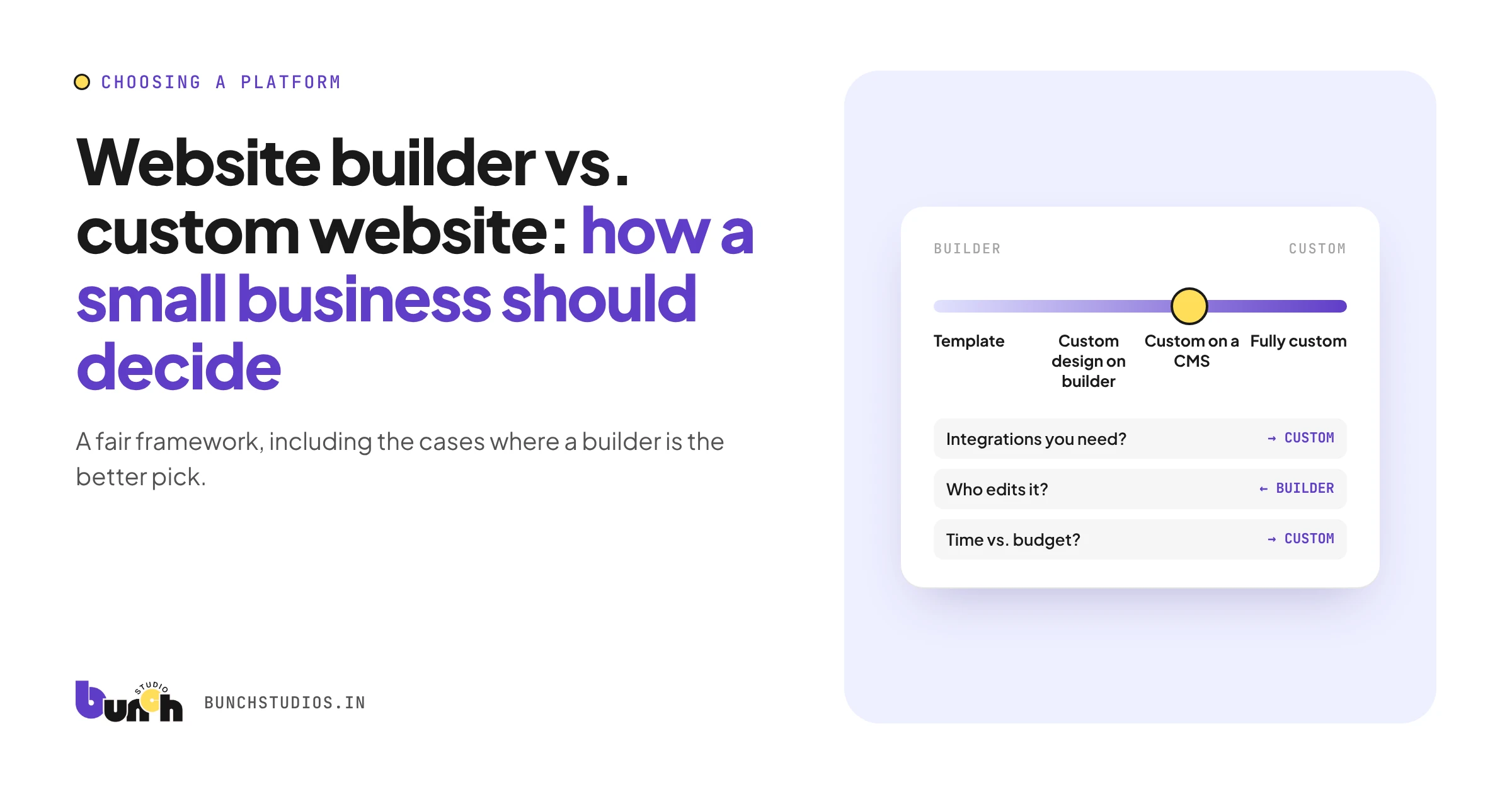
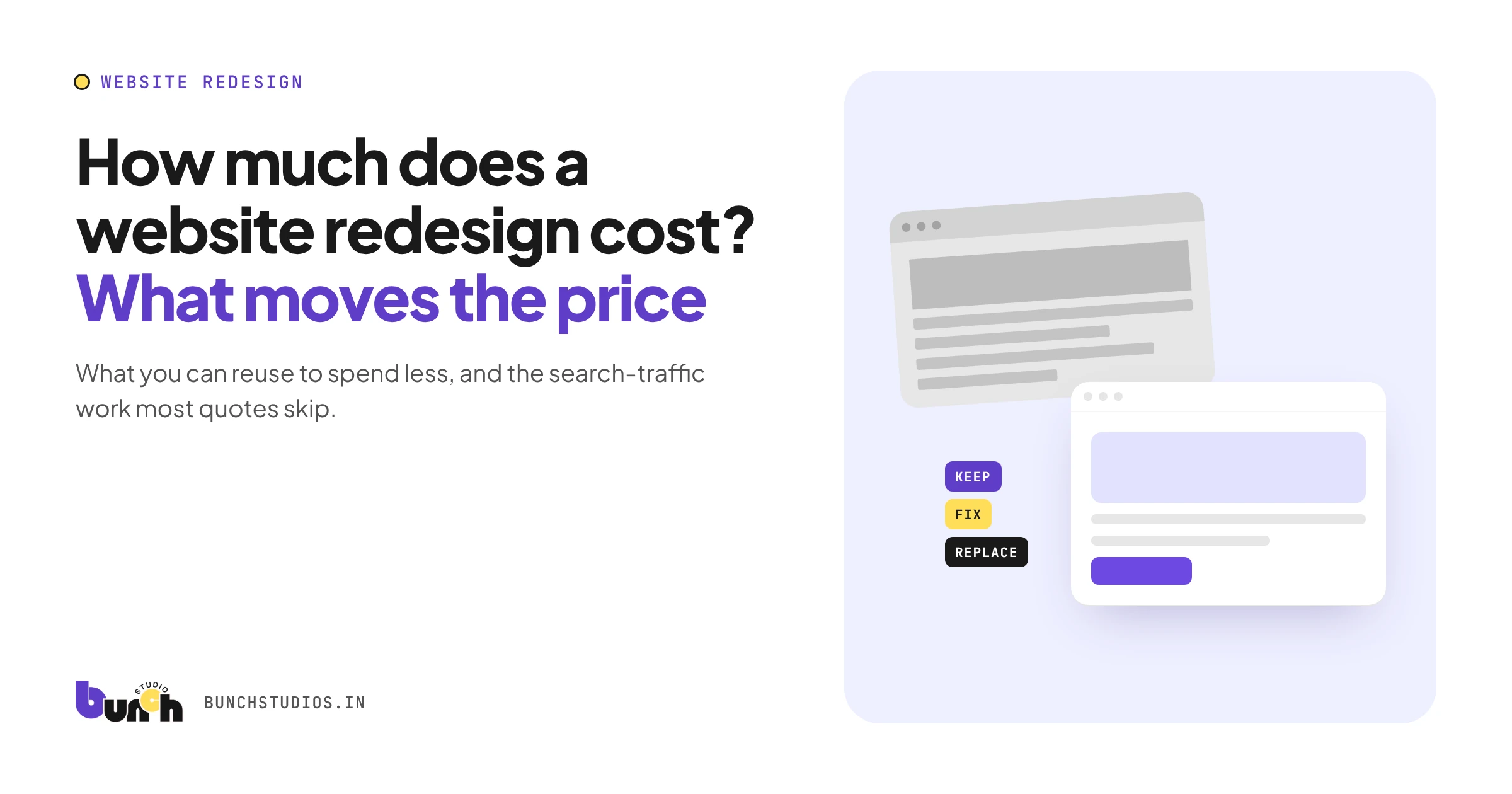
Hiring someone tends to make sense when you don't have time or copy, need integrations a builder can't handle, can't make a template fit how your business works, or want one person accountable for getting it right. Our website builder vs. custom website guide has a seven-question self-score. Replacing an existing site? See website redesign cost.
How Bunch Studios scopes a website
Bunch Studios is an India-run studio that designs and builds custom websites for US small businesses, consultants and solo founders. We don't publish fixed prices because most small-business sites need different things. Instead, here's how it works:
- Intro call: we learn about your business, customers and goals.
- Written scoped estimate: you get the scope, price and timeline in writing before any work starts.
- Design and build: you review the designs and the working site at set points.
- Launch and handover: we launch, show you how to use your CMS, and hand over access, or keep managing the site for you if you prefer.
You own the website. If you don't have copy, we draft it with AI-assisted writing based on what you tell us, and you approve every page.
Request a Scoped EstimateHow we made this guide: researched and drafted with AI assistance and checked against the sources linked above. Prices checked October 13, 2026; we re-check them when we update this page.
Sources: Squarespace pricing; Shopify pricing; U.S. Bureau of Labor Statistics, Occupational Outlook Handbook: Web Developers and Digital Designers; Clutch, Web Design Company Pricing Guide; W3C, WCAG 2 Overview. All checked Oct 13, 2026.