How to Choose a Web Designer for a Small Business
Choose a web designer on four things: relevant work you can actually look at, a clear process with written scope, ownership of your site and accounts in your name, and communication you're comfortable with. Price matters, but only once you're comparing quotes for the same scope. This guide gives you a short scorecard, the questions to ask, and the red flags, so you can compare two or three options fairly.
Disclosure: Bunch Studios is a web design and development studio. This guide is written to be useful whether or not you hire us.
Before you contact anyone: write a short brief
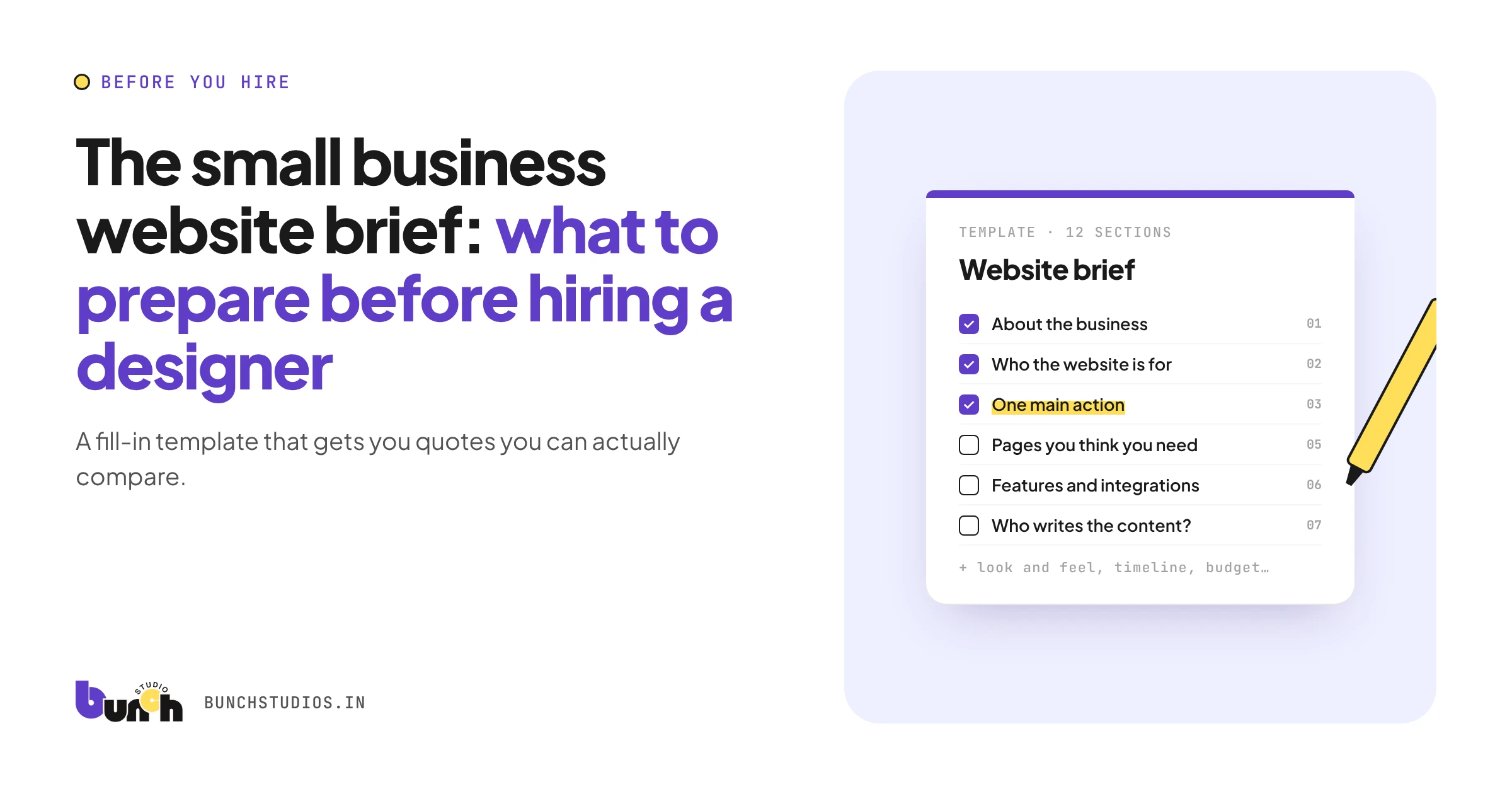
You'll get better, more comparable quotes if every designer answers the same request. Write one page covering your goals, audience, the pages you think you need, examples you like, tools you use, your timeline, and who will write the content. Our website brief guide has a template.
The scorecard
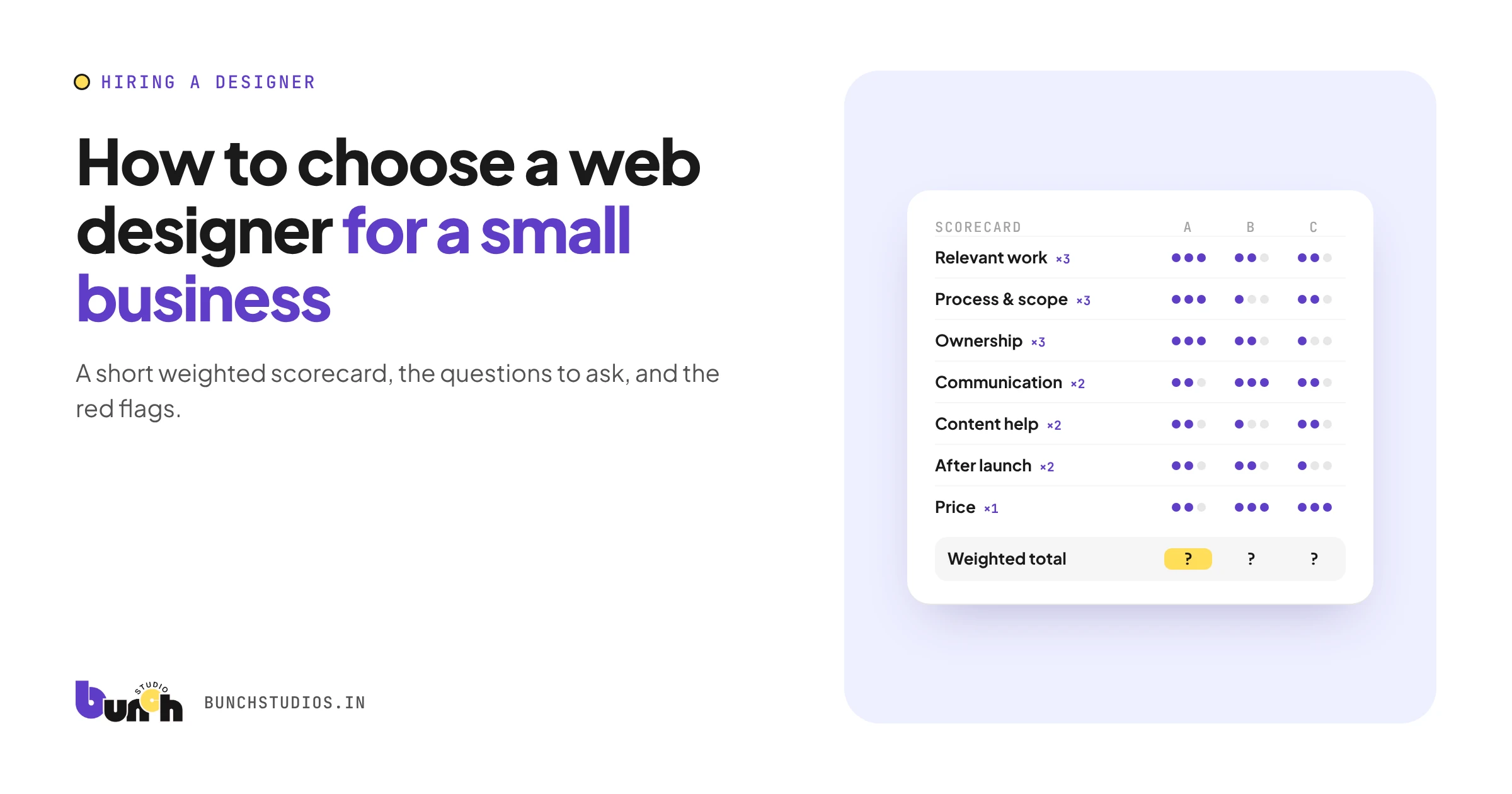
Score each candidate 1–3 on each line. The weighting reflects what usually matters most for a small business site.
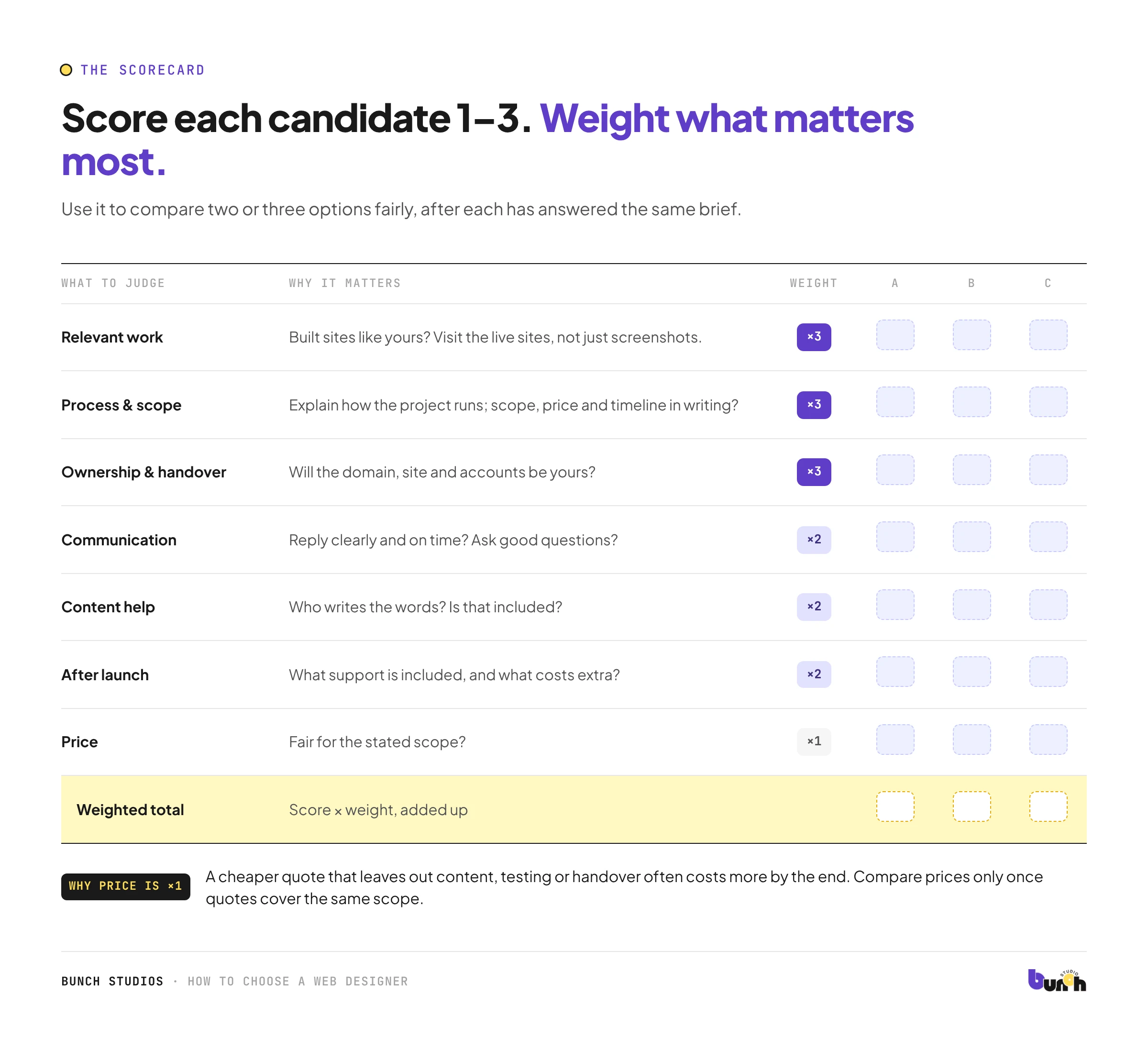
| What to judge | Why it matters | Weight |
|---|---|---|
| Relevant work | Have they built sites like yours (size, type, goals)? Visit the live sites, not just screenshots. | ×3 |
| Process and scope | Do they explain how the project runs and put scope, price and timeline in writing? | ×3 |
| Ownership and handover | Will the domain, site and accounts be yours? | ×3 |
| Communication | Do they reply clearly and on time? Do they ask good questions? | ×2 |
| Content help | Who writes the words? Is that included? | ×2 |
| After launch | What support is included, and what costs extra? | ×2 |
| Price | Fair for the stated scope? | ×1 |
Price is weighted lowest on purpose. A cheaper quote that leaves out content, testing or handover often costs more by the end.
Questions to ask (and what a good answer sounds like)
About their work
- Can I see live sites similar to mine? Good answer: links, plus what they did on each.
- What did you do on this project, specifically? Good answer: a clear description of their part.
About the process
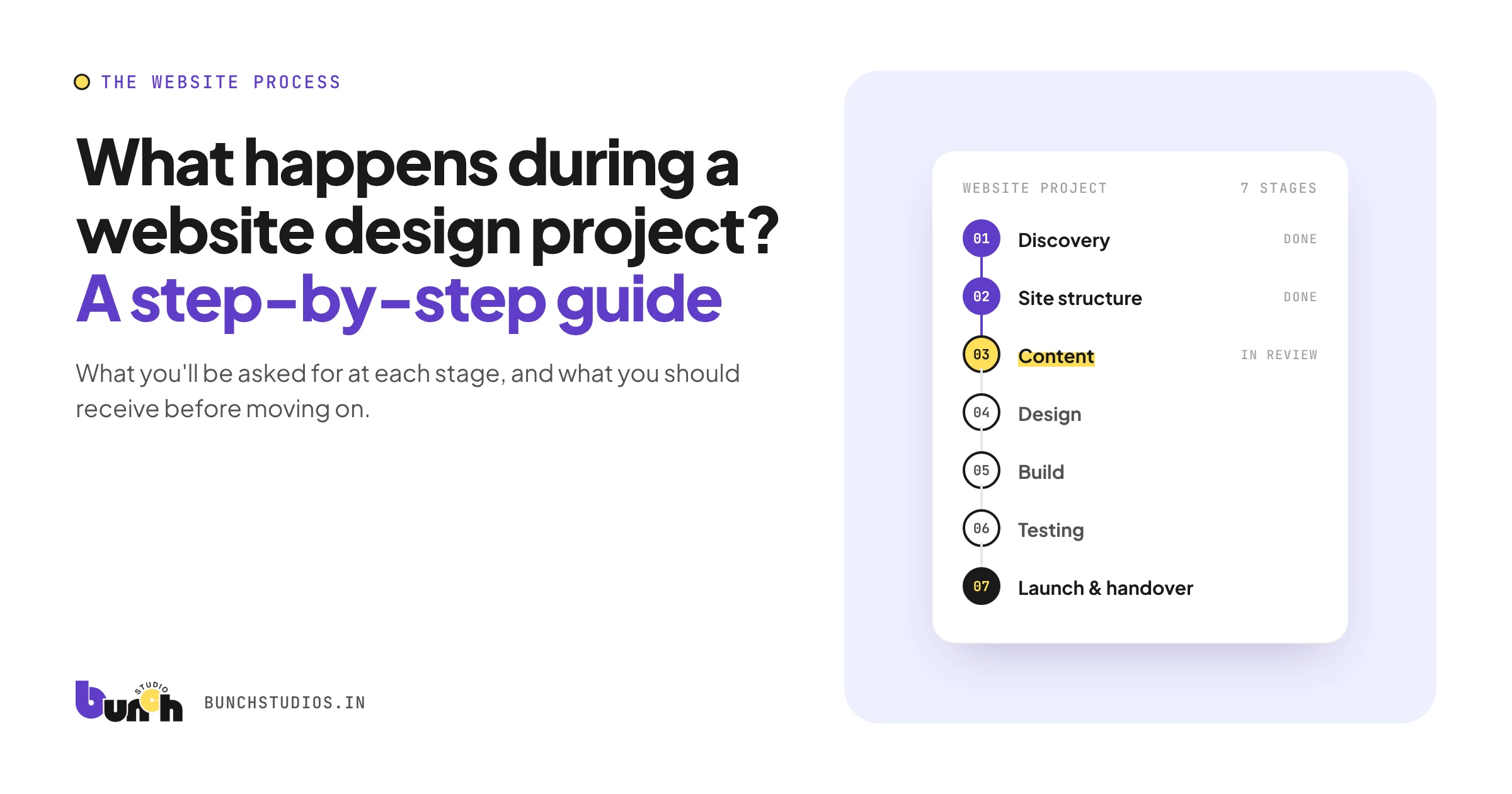
- What are the steps, and what will you need from me at each one? Good answer: named stages with your inputs. See our website design process guide.
- How many review rounds are included?
- Who writes the content?
About ownership
- Will the domain be registered in my name?
- Will I own the design and code after final payment?
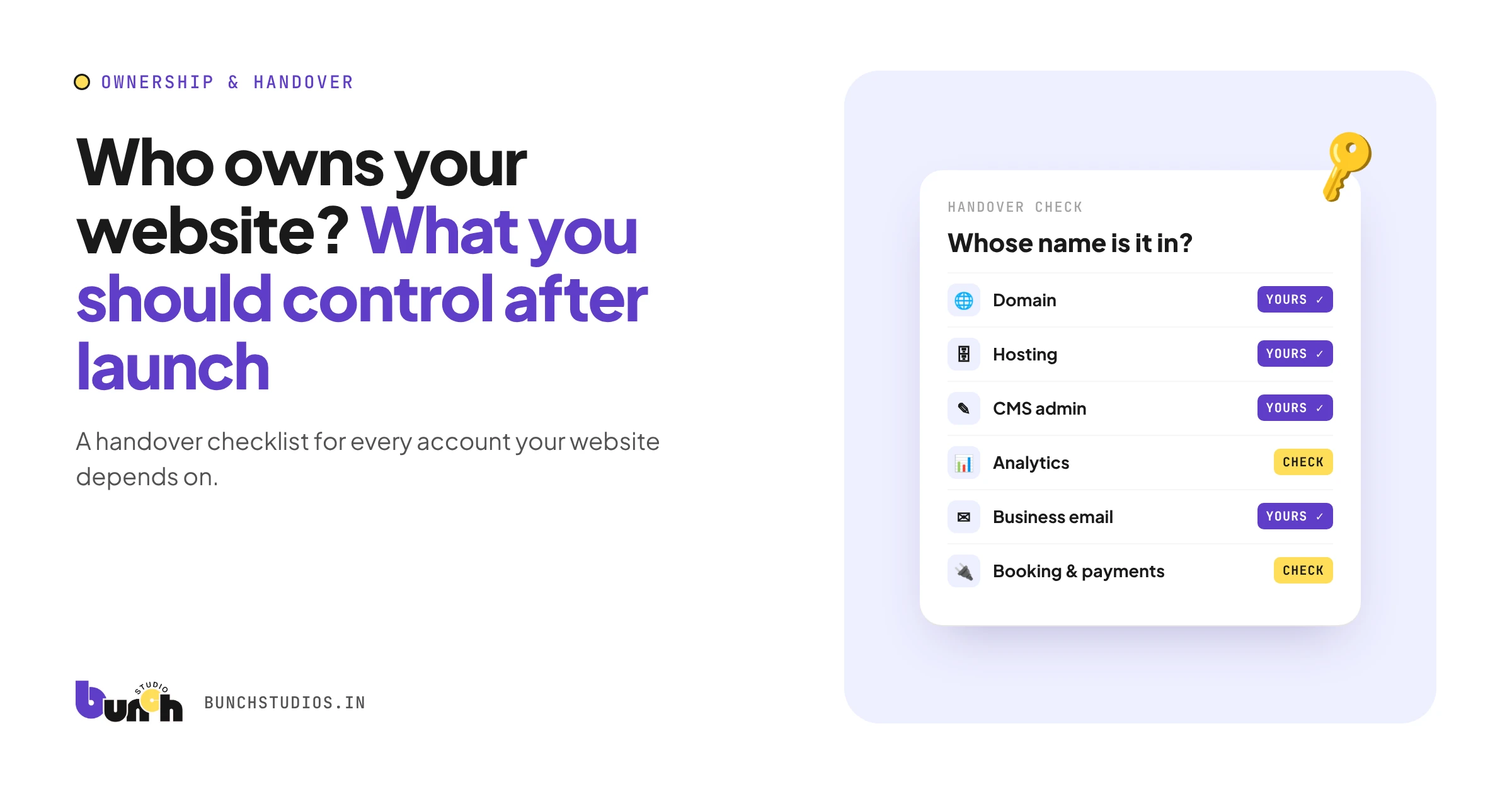
- If we part ways, how do I move my site? Our guide to who owns your website lists what to check.
About after launch
- Can I edit the site myself? What will I be able to change?
- What support is included, for how long, and what does extra work cost?
About time and money
- What does the timeline depend on?
- What's not included in this price?
What a good proposal looks like
A proposal worth signing names the pages and features included, says who writes the content, states the number of review rounds, lists what testing happens, describes what you receive at handover and who owns it, and gives a price and timeline with the assumptions behind them. If two of those are missing, ask for them in writing before you compare prices.
Red flags
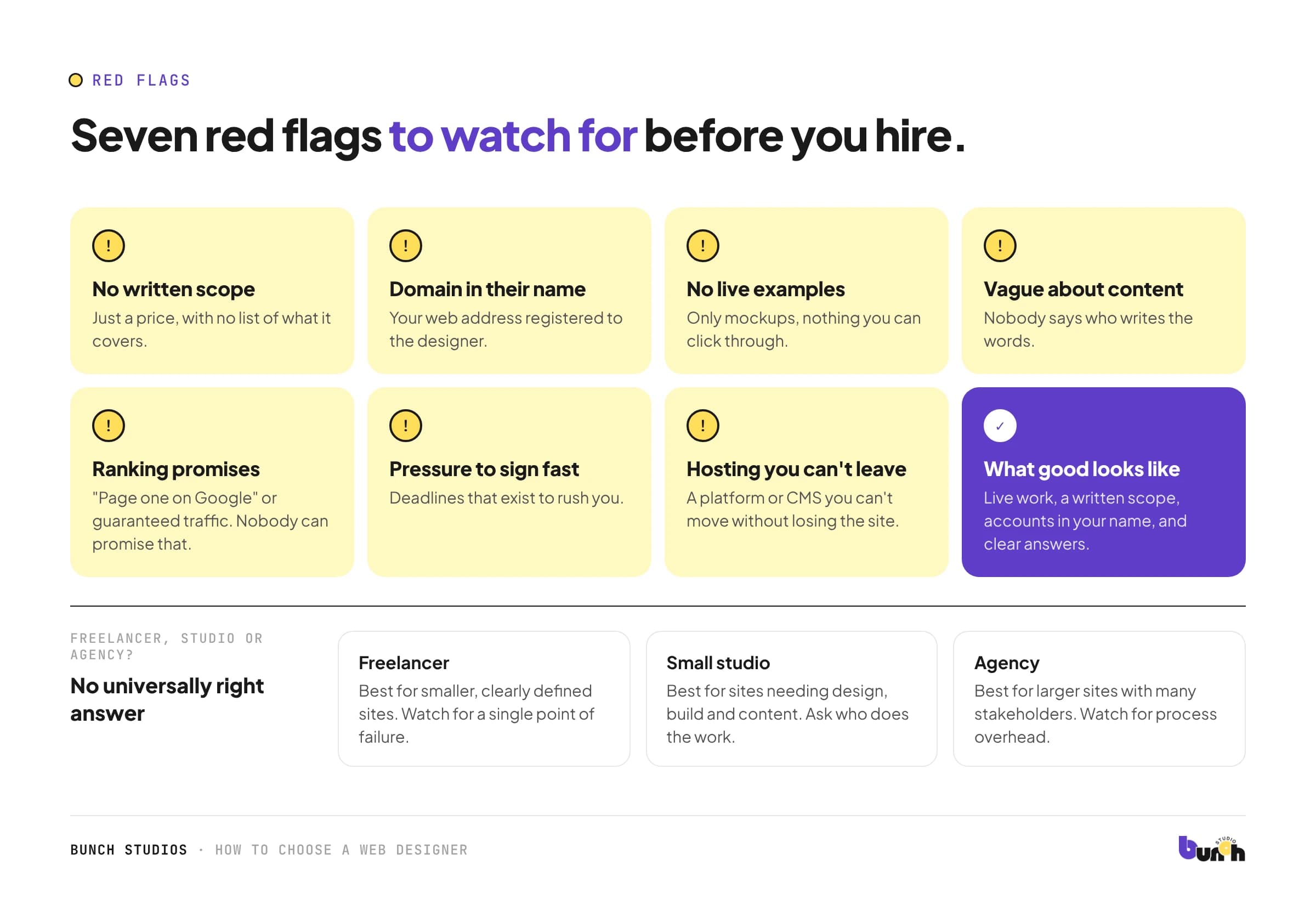
- No written scope, just a price.
- A domain registered in the designer's name.
- Can't show live examples, only mockups.
- Vague about who writes content.
- Promises of specific search rankings or guaranteed traffic. Nobody can promise Google rankings.
- Pressure to sign quickly.
- Hosting or a CMS you can't leave without losing your site.
Freelancer, studio or agency?
| Freelancer | Small studio | Agency | |
|---|---|---|---|
| Usually best for | Smaller, clearly defined sites | Small business sites needing design, build and content | Larger sites with many stakeholders |
| Watch for | Single point of failure; may not cover development or content | Team size and who actually does the work | Process overhead; junior staff on smaller accounts |
There's no universally right answer. What matters is whether one person or team takes responsibility for design, build, content and launch.
Comparing quotes like for like
Put each quote side by side and mark which of these is included: discovery, site structure, design, content, development, CMS, integrations, testing, launch, training, post-launch support. Only then compare prices. Our website cost guide explains what each line covers.
How Bunch Studios answers these questions
- Process: intro call → written scoped estimate (scope, price, timeline) → design and build with set review points → launch and handover.
- Ownership: you own the website.
- Content: if you don't have copy, we draft it with AI-assisted writing and you approve every page.
- After launch: manage it yourself with a custom CMS built for what you edit, or have us manage hosting and updates.
- Location: we're an India-run studio working with US clients, and we reply within 24 hours.
How we made this guide: drafted with AI assistance.